One API call for any
company's brand identity

Webflow

Linktree

Framer

Figma

Dribbble

Airbnb
Colors
About
Webflow is a visual web design platform that lets anyone build, launch, and grow custom websites without writing code.
San Francisco, California
501 - 1,000 employees
Privately Held
Logos




Fonts
Aa
Aa
Inter - Headline font
+15 more brand data...
Pull rich firmographic data from any website URL
Global coverage
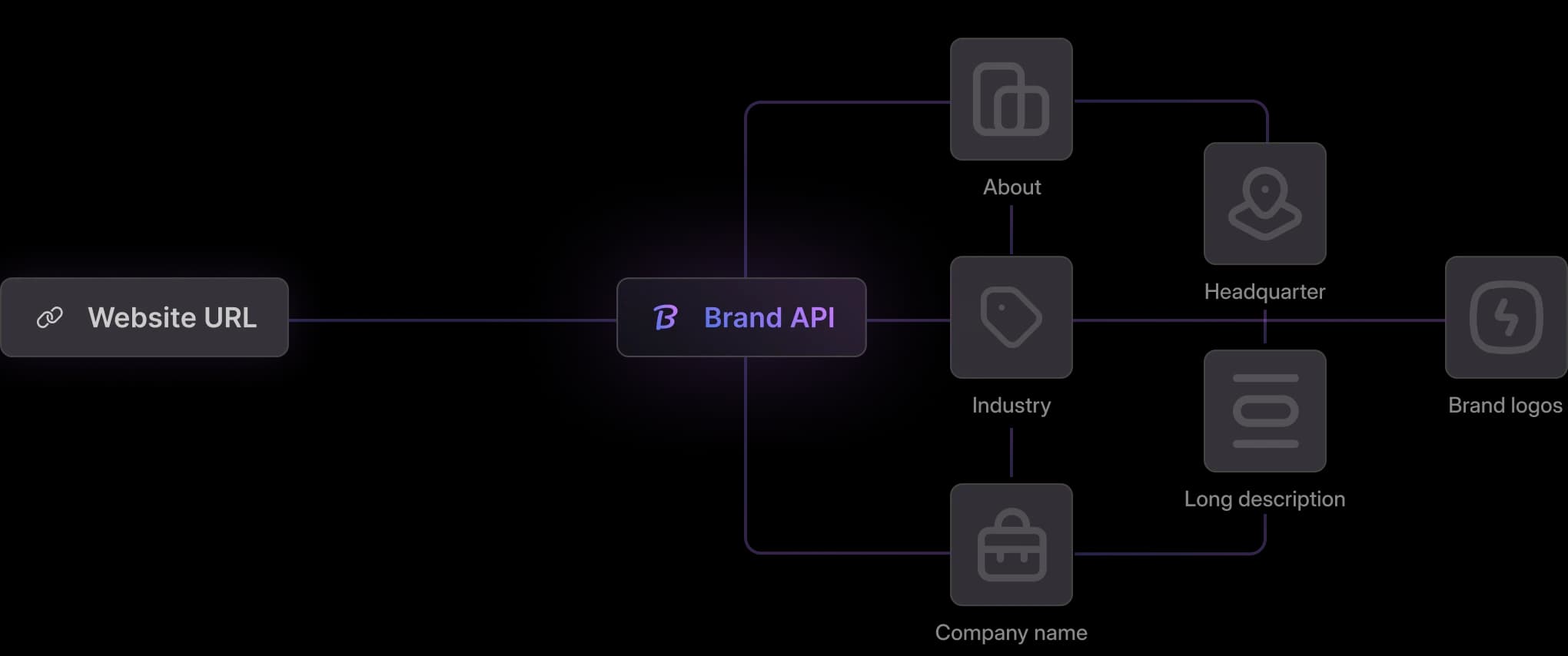
Transform any URL into a rich company panel information
Brand story
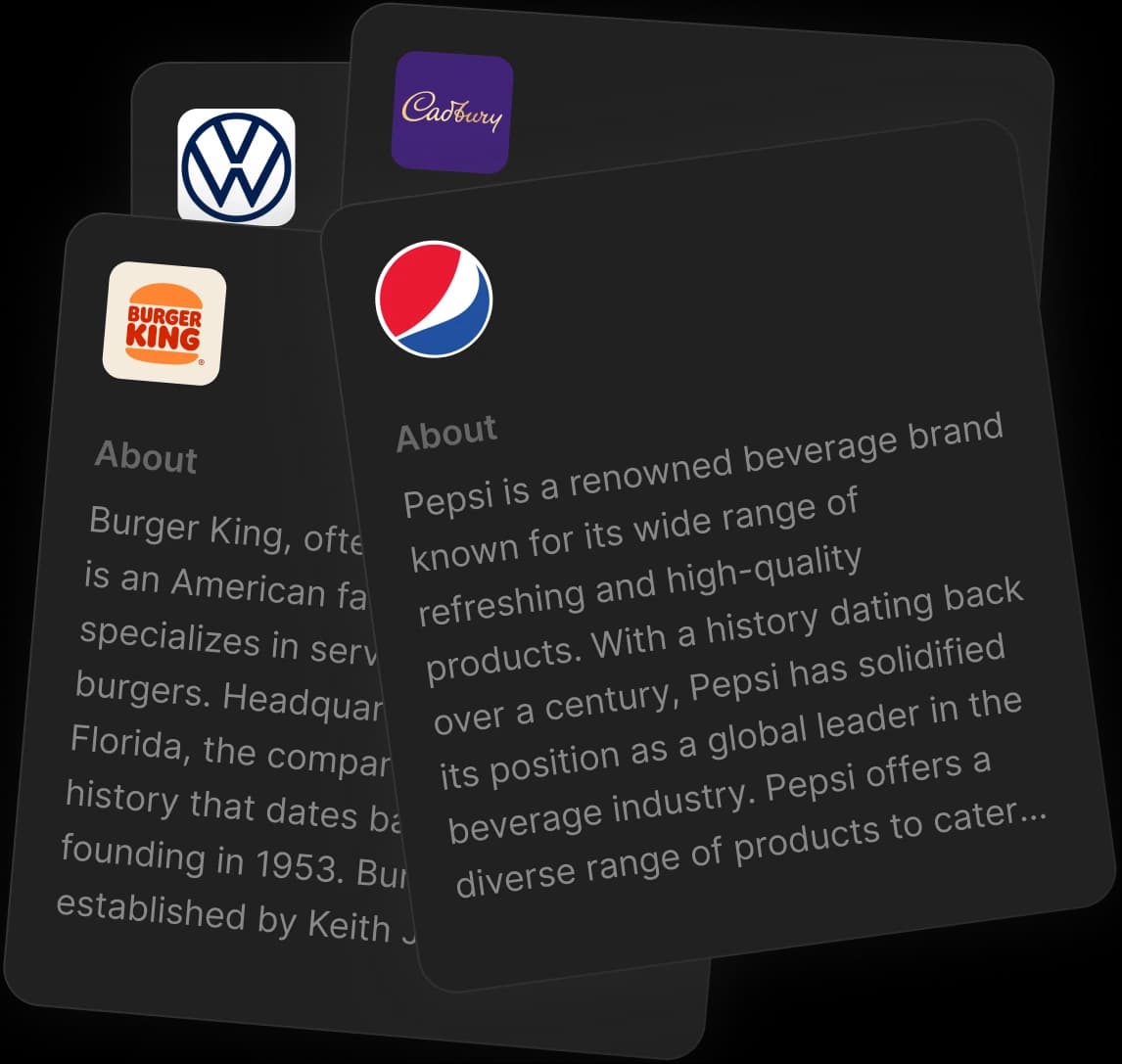
The story behind each brand
Convert any URL into a rich 200 character AI-description based on the content of their website.
KYC
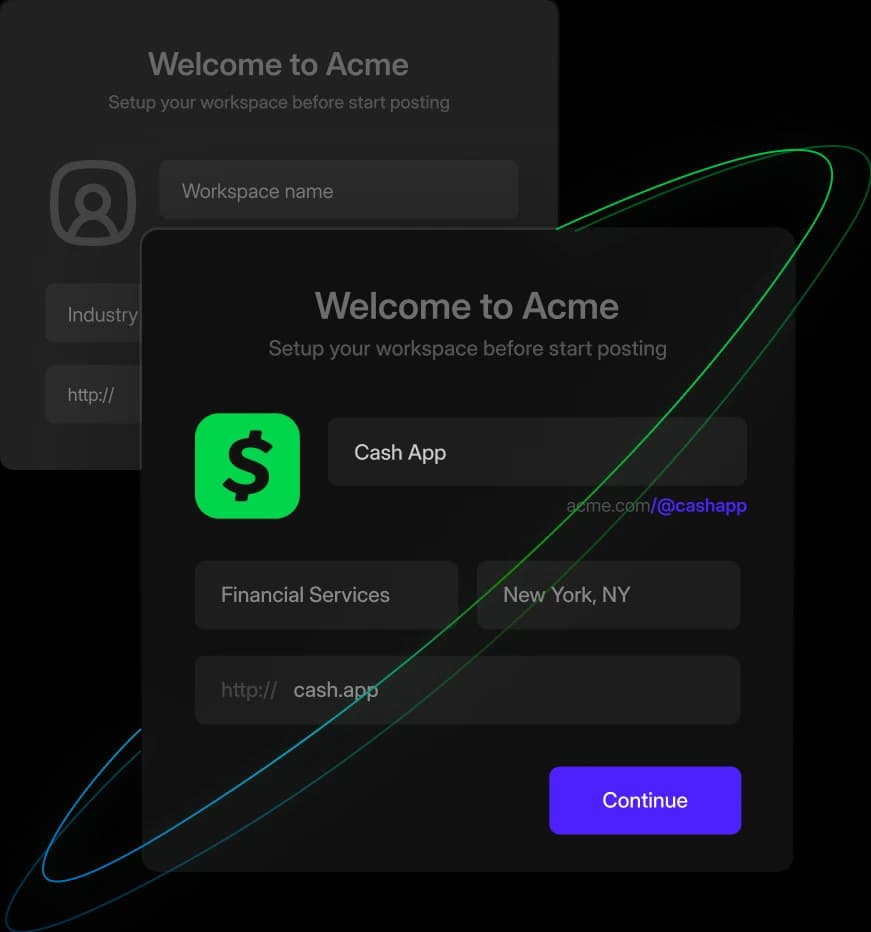
Onboard like 1, 2, 3
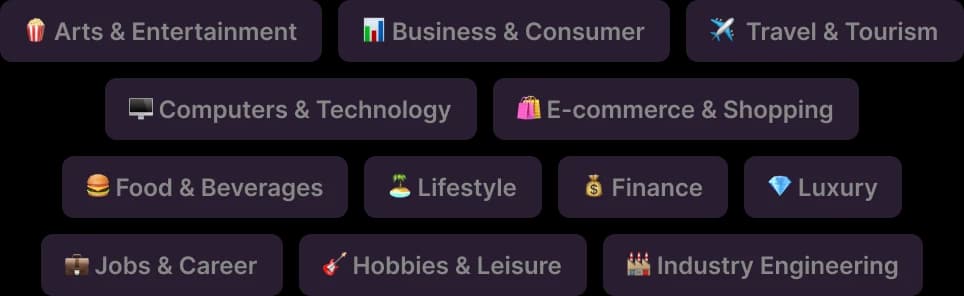
Industry
Classify brands in real-time using their URLs
Firmographics
Extract social profiles, description and more
Live sample
Dataset explorer
First-party data
50M+ companies
Global coverage
99.9% API uptime
Frequently asked questions
Your questions, answered
What is Brand API?
Brand API is a brand lookup service. You send a domain, ticker, ISIN, or crypto symbol, and get back a single structured response with the brand's visual identity and company data: logos, icons, and symbols in multiple themes and formats, colors with roles, fonts, firmographics, and social links.
It is powered by an always-on index of millions of brands, kept current through continuous rebrand tracking and human review.
How is it better than scraping logos or using a favicon service?
- Always current: latest logos and colors, kept fresh by continuous rebrand tracking and human review, not a favicon that went stale years ago.
- Real assets, not 16px icons: transparent SVG and PNG in the right theme, brand colors with roles, and fonts.
- Coverage where DIY breaks: above 95% logo coverage on core brands, and about 86% even on random global micro-businesses. A scraper or favicon service falls off a cliff on the long tail.
What datapoints are returned?
Logos, icons, and symbols in multiple themes and formats (SVG, PNG, WebP, JPEG). Brand colors with roles (accent, dark, light, brand) and brightness. Fonts for titles and body with their source. Banner and other images. Company firmographics: employee range, founded year, industries, headquarters location, organization type, and financial identifiers (ticker, ISIN). Plus social links, a quality score, and an NSFW flag. See the full schema or try the playground.
What is the coverage?
Every live domain. If a brand is already in our index it returns instantly. If not, we index it live from the site. That means global coverage across size, geography, and industry, with no fixed list and no waiting for a brand to be added.
How accurate and fresh is the data?
Data comes primarily from first-party sources: the brand's own website and managed social profiles, cross-checked across them. Every brand carries a quality score from 0 to 1, split into low, medium, and high thirds, so you can filter out weak matches. The score factors in recency, whether the brand claimed its profile, manual verification by our team, and the domain's web ranking.
We keep it current through continuous rebrand tracking, data partnerships, merchant self-verification, and a correction and escalation workflow, with human review where it needs judgment. Subscribe to webhooks to be notified when a brand changes.
We measure coverage on two samples: a core set of mostly US and EU public and private brands, and an uncurated global set of long-tail micro-businesses pulled at random from Google Maps across 16 cities.
- Logos: 95%+ on core brands, ~86% on long-tail.
- Colors: 97% on core brands, ~80% on long-tail.
We do not pad. A null means the public signal is genuinely weak or missing, which is itself a signal of low brand maturity.
Can I use the logos?
Logos are the property of their trademark owners, and use must follow fair use. Referencing or identifying a brand is fine, like showing a company's logo in a listing. Putting someone else's logo on your own product, implying affiliation, or altering it is not. See the logo fair use guide. If you are unsure, get permission from the owner or consult a lawyer.
How do I look up a brand without the domain?
Query by stock or ETF ticker, ISIN, or crypto symbol using the typed routes, for example /v2/brands/ticker/NKE. If you only have a company name, use the Brand Search API to resolve it to a domain first.
Do I need the Brand Context API too?
They do different jobs. Brand API covers the visual layer plus firmographics: logos, colors, fonts, company metadata. Brand Context API covers the semantic layer: mission, positioning, voice, audience, products. They share one credit pool at one credit each.
How does pricing work?
Usage is metered in brand fetches, one per call. $129/month (or $1188/yearly) includes 2,500 brand fetches per month shared across Brand API, Brand Context and Transaction API. Fetches reset monthly and do not roll over. Overage is $0.10 per fetch. Logo and Brand Search APIs have separate limits. Requests for brandfetch.com are free and do not count toward your quota. See pricing.
Can I get the data in bulk or for enterprise use?
Yes. Most large customers start with a one-time bulk delivery of the full dataset as CSV or JSON to your S3 or SFTP, then keep it fresh with webhooks and targeted API calls. We can adapt the delivery model to your setup. Talk to sales.
What is the latency?
Cached brands return near-instantly. A domain indexed live for the first time takes longer depending on the site's complexity, then it is cached for the next calls.
Do you support MCP?
Yes. A production MCP server exposes Brand API tools (brand lookup, logo URLs, and search) to Claude, ChatGPT, and other clients. See the docs.
Also from Brandfetch