
Can you walk us through the early days of Shutterstock and how the company has evolved since?
Shutterstock started in 2003 as a stock image company. It was a scrappy startup without a full-blown brand identity at the time.
As the company began to scale, we expanded both our solutions and capabilities. We started with the marketplace, offering different asset types, and broadened into AI and custom production with Shutterstock Studios.
In terms of our brand identity, the original logo was created around 2007. It was centered around Shutterstock as a stock image company—something reflected in everything from the logo to the color palette. It was pretty bare bones, a really tightly structured brand identity.

Image courtesy by Shutterstock
What specific goals or challenges led to the decision to rebrand Shutterstock?
From a brand perspective, Shutterstock hadn’t really done a full-blown effort in repositioning or reintroducing ourselves to the audience. The identity created in 2007 stayed pretty constant up until this rebrand.
The reason for the timing now came from looking at the market, the industry, and the world.
As we looked at our offerings, the new solutions beyond our expanded asset types—like custom production and generative AI—became part of our toolkit for customers. That was the signal that a bigger change was happening. It was time to show we are staying current, ambitious, and experimental, while shaping the future and changing people’s perception of what Shutterstock is.
This rebrand really required an entirely new container to rethink how we act, how we behave, and how we show up in the world so that it matches what we offer.

Image courtesy by Shutterstock

Image courtesy by Shutterstock
In your two years with Shutterstock, have you noticed any shifts in how customers are engaging with the brand or its products?
As a company, we’re always listening to our customers and looking at what we offer—and what we can bring to the table. This is a big part of our new brand story: we’re focused on impact. We know our customers want to create work that makes an impact in their own worlds. So we’re always adding tools and solutions to our toolkit that can help them take their work further.
Our brand language now reflects the idea: “You can do it yourself. You can do it with help. Or we can do it for you.” That’s a shift for how we want people to consider Shutterstock—we’re here to help create impact, in whatever way our customers need.

Image courtesy by Shutterstock
We’re your creative partner, here to help fuel your work. That’s where our new brand identity really lands. It’s about acceleration and propulsion—not just creativity for creativity’s sake, but creativity that makes an impact and resonates with people. That’s where Shutterstock can be really special in the equation.

Image courtesy by Shutterstock

Image courtesy by Shutterstock
Can you walk us through your role in leading the rebrand, and what it was like handling it in-house? What were some of the biggest challenges your team faced along the way?
It was definitely a cross-functional effort. We had a great agency partner who helped us land the strategy, and then we brought the creative work in-house.
Even taking it in-house, I was lucky to have such a talented multidisciplinary creative team. We worked closely with our executive leadership, brand strategy, comms, legal, product, and UX—it was truly an all-hands-on-deck effort. I think that’s why it was so successful: everyone was deeply invested, understood the assignment, and recognized we needed to evolve.

Image courtesy by Shutterstock
The biggest challenge wasn’t alignment—it was time. Balancing day-to-day business operations while investing the energy needed for something strategically grounded and beautiful is always tough.
That said, working cross-functionally ended up being a highlight. As a creative lead, it was such a unique experience to sit in rooms with people outside the traditional creative space, talk through logos, designs, colors, fonts, and feel their genuine investment. People were curious, asked questions, and truly collaborated to build this thing together. It turned out to be a really beautiful experience—and a very different one for my career.

Image courtesy by Shutterstock
The new logo removes the viewfinder and replaces it with a ripple effect on the “o.” What’s the story behind this change, and what message does Shutterstock aim to convey?
This was a huge part of our discussions. Like with any large brand identity, the strategy had to come first. We started by asking: What is the root of our brand? What’s our white space? It all came down to this idea of fueling great work—not just for Shutterstock, but for our customers.
The original logo’s viewfinder in the “o” signaled photography. But as our offerings expanded beyond images into other asset types, it felt limiting. We had this “aha” moment: what if we close the viewfinder, back into an “o,” and use it as our emphasis point for impact? That led to a lot of exploration on how to visualize impact.
We landed on the idea of an impact mark—a ripple effect. Now our “o” is a catalyst. In motion, it drops in, creates impact, and ripples out. We weren’t looking to reinvent everything—we wanted the change to feel familiar yet new. This approach allowed us to reappraise the identity while staying connected to our roots.
Even the wordmark is an evolved version of the original. We wanted to avoid a jump-scare redesign; the similarities are intentional. The strategy here is key: the logo isn’t just a visual flourish, it’s tied to our core message and identity.
The impact mark has become more than a logo—it’s a storytelling tool. We shaped it into a form that can live across all marketing materials. It animates beautifully and carries the idea of impact through our entire visual identity, not just at the logo level.

Image courtesy by Shutterstock
"The ripple effect is a symbol of expansion, reach, and how our brand creates impact."
The updated brand identity also introduces an expanded color palette. Can you walk us through the thinking behind the new colors?
Our old palette was primarily red with black and white. Working with the brand every day, we realized we needed more colors in the toolkit—especially as brand and product meet. In a product experience, one accent color isn’t enough.
We started by thinking about our customers—creative leaders who want to make an impact. Designing from their perspective meant looking at the tools they use every day: sticky notes, highlighters, file folders, card stock. Those familiar colors became inspiration.
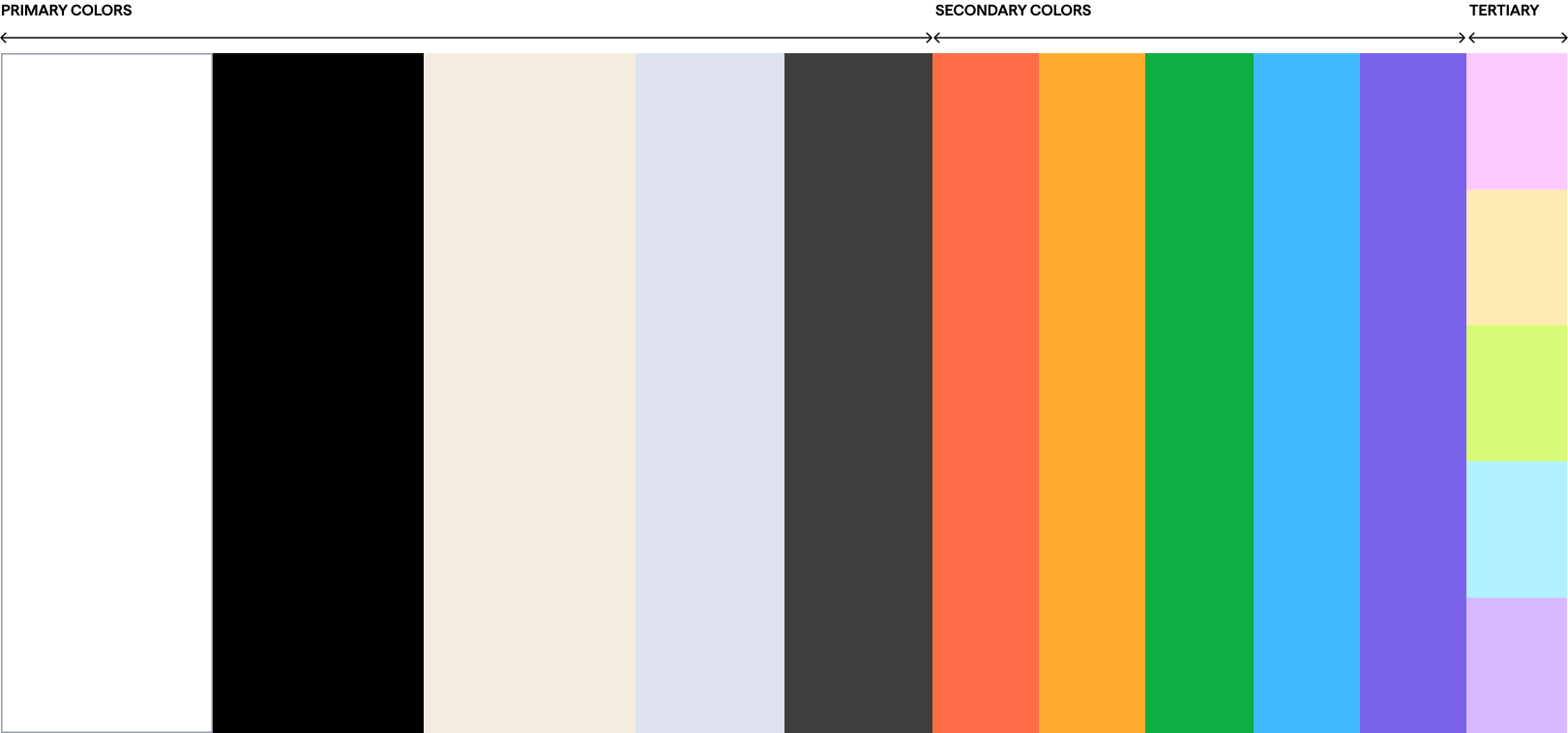
Image courtesy by Shutterstock
Our secondary palette includes brighter primary colors and lighter hues we call “highlighters.” But our primaries are still neutral—black, white, and tan. This was intentional.
Those neutrals are workhorses. They soften and mature how we use color. Strategically, you’ll see more black, white, and tan leading, with pops of color for emphasis. This lets us turn the volume up for expressive moments, or pull it back for a more mature tone—depending on the message.
As a creative leader, that flexibility is key. We can meet customers where they are with the appropriate visual and verbal tone.

Image courtesy by Shutterstock
How does the new brand direction reflect Shutterstock’s ongoing commitment to creative communities? Was there an effort to reconnect with the platform’s original spirit of empowering visual creators?
Since our founding, Shutterstock has championed human-first creativity. The rebrand was a chance to double down on that foundation and reaffirm our role as a true creative partner, not just a content provider.
We designed the new identity to reflect the dynamic, evolving nature of creative work today. From the expressive ripple in our logo to a more flexible system of solutions built to meet customers where they are, everything was crafted to inspire and empower. Whether you're an independent artist looking for visibility or a global brand team building at scale, the rebrand makes clear that Shutterstock is here to fuel great work—on your terms. It’s both a nod to our roots and a signal of what’s next.

Image courtesy by Shutterstock

Image courtesy by Shutterstock
Is there anything in the new identity that stands out as a major shift from before?
We wanted to make our values visible. At a brand level, we wanted Shutterstock to feel like the kind of partner our customers actually want at their side—energized, optimistic, and focused on real outcomes.
That led us to define a new tone of voice: distinct, spirited, impactful, and relatable. Before the rebrand, we didn’t have a clearly defined tone, so putting that in place gave us guardrails to ensure we show up consistently—both internally and externally.

Image courtesy by Shutterstock
We also wanted to express the shift from being a content vendor to being a full-service creative engine. Our identity system gives us the room to tell that story, from the typeface Haffer—which balances personality and clarity—to a flexible design system that can move from expressive to grounded.
Finally, the brand needed to signal ambition. Our customers are creative leaders trying to move the needle. The impact mark, the shape system, and the tone all ladder up to one clear purpose: helping people fuel great work.

Image courtesy by Shutterstock
What did you learn about the Shutterstock rebrand that actually surprised you the most?
The biggest takeaway for me—especially working at a global company—is that it’s a different beast. Talking to people across the company and understanding how they’re using the brand in their day-to-day lives was eye-opening.
A great example is our global sales team. Making sure they have all the tools they need in their toolkit helps them be effective at their jobs and truly act as brand ambassadors.
It was also a reminder for me that you think you know it all—but you don’t. You need to go talk to people, step away from your screen, and really see what their day-to-day looks like. How are they actually using the brand? It was a good exercise in checking assumptions and replacing them with real insights.