


Charges, history, renewals and cash
Transaction API
Merchant names and logos in your feed
Transaction API matches each card, bank or ATM line to the merchant and returns its name and logo.
Boost merchant recognition. Help users instantly identify merchants in transaction feeds with logos and brand assets.
Verify merchant authenticity. Confirm that merchants are who they claim to be using verified brand metadata.


Disputes
Fewer disputed charges
A charge with a name and logo is one the cardholder recognizes. Fewer of them turn into fraud claims.
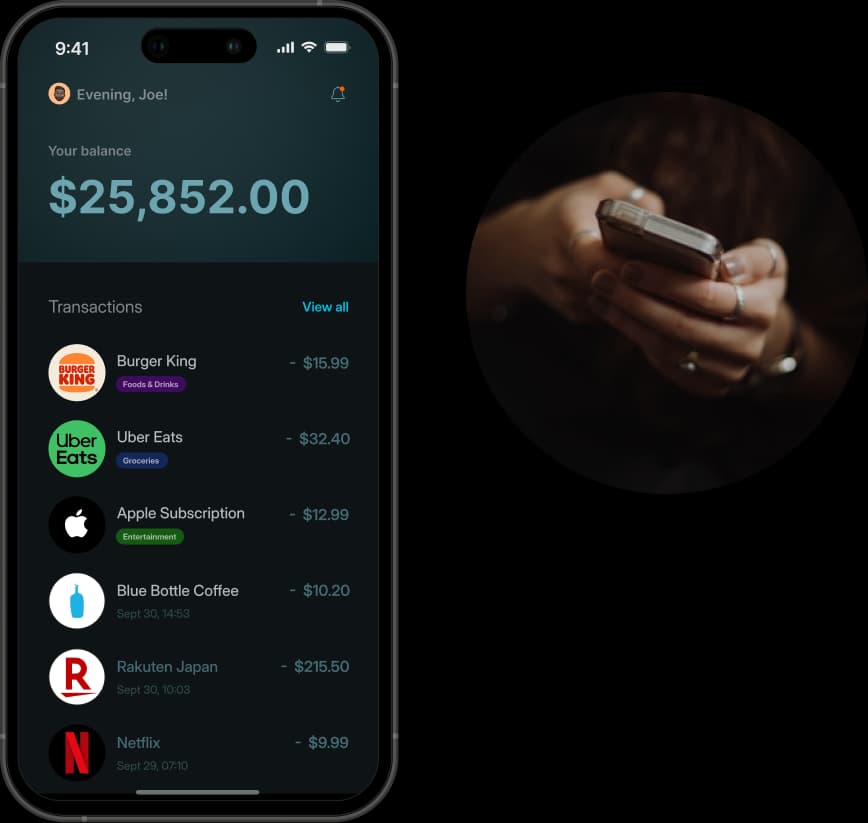
Transaction history
Readable transaction history
Every purchase shows a name, logo and category, so a month of spending takes seconds to scan.
Subscriptions
Recurring charges in one list
Every renewal shows the merchant’s name and logo, so users cancel what they forgot instead of disputing it.


Cash withdrawals
ATM withdrawals show the bank
Cash withdrawals carry the bank’s own name and logo, so they never look like an unknown charge.


See it work
Five real transactions
Each example is a real statement line and the brand profile the API returned for it.

Apple

Netflix

Bank of America

Deliveroo

Booking.com
Card statement line
What your user sees

Apple
apple.com
Apple designs and sells consumer electronics, software and services, including iPhone, Mac and iPad.
Want your transaction feed to show merchants your users recognize?
This prompt gives your AI coding tool everything it needs to build it in your framework.
The problem
A charge nobody recognizes turns into a support ticket
Processors, gateways and acquirers all add their own prefixes and IDs. By the time a payment reaches your app, the merchant’s name is buried in the descriptor.
Disputes and chargebacks
Users report charges they can’t place as fraud. Each one opens a dispute case.
A history nobody can read
Rows of uppercase codes send users to support asking “What is this charge?”
Renewals nobody remembers
Renewals bill under names users forget, so they dispute instead of cancelling.
ATM lines nobody can place
Most ATM lines don’t name the machine’s owner, so out-of-network fees surprise users.


Compliance and security
Security and contracts
A 99.9% uptime SLA, audited security, and a team that handles your vendor review.
SOC 2 compliant
Security documentation available for compliance review.
99.9% Uptime SLA
Guaranteed availability backed by contractual commitments.
Dedicated support
Named account manager with priority response times.
Procurement-ready
MSA review, security questionnaires, and vendor onboarding.
Flexible licensing
Flat-fee, self-hosting, and multi-year terms available.
Zero data retention
Request metadata isn’t stored in Brandfetch’s logs or analytics.
Playground
Dataset explorer
First-party data
50M+ companies
Global coverage
99.9% API uptime
Frequently asked questions
Your questions, answered
Which transactions does this work for?
Any line that names a merchant: card purchases, bank payments and ATM withdrawals at a bank’s machine. Send the raw line and a country code. Inputs, logo formats and rate limits are on the Transaction API page.
How does this reduce chargebacks?
Users dispute charges they can’t place. Show the merchant’s name and logo on the transaction row and on the dispute form, so users can check the charge before filing a claim.
Envestnet | Yodlee reports fewer chargebacks for its clients after adding Brandfetch.
How does this help with subscriptions?
Renewals often arrive as a billing line like NETFLIX.COM 866-579-7172. The API resolves it to Netflix, so users can tell which service each charge is for. To list subscriptions in one place, group recurring charges by the returned domain.
How are ATM withdrawals handled?
Send the ATM line as the descriptor. When it names the bank, the API returns that bank’s brand: BKOFAMERICA ATM 10/08 #000004417 WITHDRWL resolves to Bank of America.
Lines that only name a network or a terminal ID return a 400, and the call isn’t billed.
Can I show logos for stocks and ETFs?
Yes. Send a stock or ETF ticker, or an ISIN, to the Logo API or Brand API.
A stock returns the company: AAPL returns Apple. An ETF returns its issuer: VOO returns Vanguard and QQQ returns Invesco.